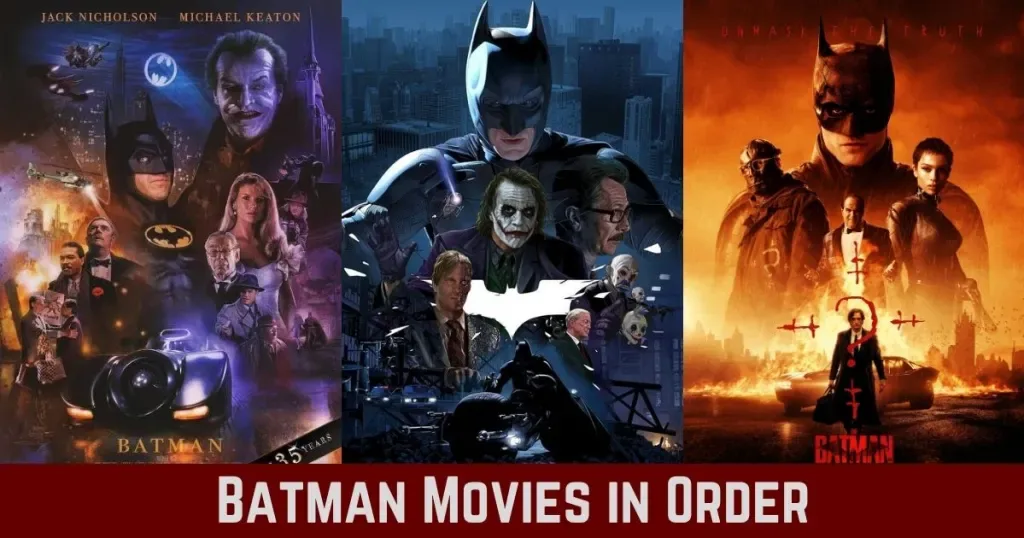
Watch the Batman movies in order of release to explore the main live-action film history, or choose one actor's era for a shorter story. The films don't all follow the same Bruce Wayne. Christian Bale's trilogy, Ben Affleck's crossover appearances and Robert Pattinson's The Batman need separate labels.
What is the Batman movies in order release checklist?
This table follows DC's official live-action guide, which focuses on movies with a major Batman role. The two Justice League versions are shown separately as cuts, rather than consecutive adventures.
Film | Year | Version |
|---|---|---|
Batman | 1966 | Adam West |
Batman | 1989 | Michael Keaton |
Batman Returns | 1992 | Michael Keaton |
Batman Forever | 1995 | Val Kilmer |
Batman & Robin | 1997 | George Clooney |
Batman Begins | 2005 | Christian Bale |
The Dark Knight | 2008 | Christian Bale |
The Dark Knight Rises | 2012 | Christian Bale |
Batman v Superman: Dawn of Justice | 2016 | Ben Affleck |
Justice League | 2017 | Ben Affleck |
Zack Snyder's Justice League | 2021 | Ben Affleck, alternate cut |
The Batman | 2022 | Robert Pattinson |
The Flash | 2023 | Crossover |
Use release order if comparing performances and filmmaking eras is part of the fun. If you want one continuous story, choose a group below instead of treating the entire table as a single biography.
What is the Dark Knight trilogy order?
Watch Batman Begins, The Dark Knight and The Dark Knight Rises. Those three films form Christopher Nolan's trilogy with Christian Bale as Bruce Wayne and Batman.
The official Dark Knight Rises page describes the 2012 film as completing the trilogy. There's no need to insert Batman Forever or a Justice League cut between its entries.
We recommend this route if you want a self-contained three-film project. Our Christian Bale page offers optional performer background after you've watched.
Which older films belong together?
The 1989 Batman, Batman Returns, Batman Forever and Batman & Robin form the older four-film run identified by DC. The change from Keaton to Kilmer and Clooney doesn't mean you should jump to the later Nolan films between entries.
The 1966 Batman is a separate Adam West version. Watch it as its own movie-night option rather than trying to force its tone or setting into the later series.
Where does Ben Affleck's Batman fit?
His major-role route begins with Batman v Superman, continues with Justice League in your chosen cut, and extends to The Flash. Keep that route separate from Bale's trilogy.
Justice League from 2017 and Zack Snyder's Justice League from 2021 are alternative presentations. Watching both can be useful if you're interested in comparing versions, but don't interpret the later cut as the next mission after the earlier one.
Our published Ben Affleck biography covers his broader acting and directing career. It isn't required context for the viewing order.
Is The Batman a sequel to The Dark Knight Rises?
No, treat The Batman as a separate version. The official film page identifies Matt Reeves as director and Robert Pattinson as Bruce Wayne and Batman.
You can choose the 2022 movie without first completing Bale's trilogy. The similar titles and recurring character names don't mean the actors are playing consecutive stages in one life.
Why doesn't every change of Batman actor mean a new timeline?
The actor and the continuity are related labels, but they aren't interchangeable. The older run moves from Keaton to Kilmer and Clooney while continuing the film sequence identified by DC. Nolan's Batman Begins, on the other hand, starts a different version rather than acting as the next chapter after Batman & Robin.
Distinguish those changes before selecting a route. If you stop after Batman Returns because Keaton's name disappears from the next rows, you are choosing an actor-focused watch. If you continue to Batman Forever and Batman & Robin, you are following the older four-film run.
Both choices can serve a purpose. The problem comes from assuming one label answers every question. Keep the film title, actor and continuity together in your notes so you can tell whether you are following screen history, one performance or a connected group of stories.
Which Batman route is the smallest useful commitment?
The Batman offers a separate modern starting film, while Nolan's trilogy offers a defined three-film project. The older four-film run and Affleck's crossover route are other choices. We would choose according to what you want to experience before committing to the entire release-history table.
Viewing goal | Starting point | What comes next? |
|---|---|---|
A separate modern introduction | The Batman | Finish that film before choosing another branch |
A complete three-film project | Batman Begins | The Dark Knight, then The Dark Knight Rises |
The older connected run | Batman from 1989 | Returns, Forever, then Batman & Robin |
A broader live-action history | Batman from 1966 | Follow the release table with each continuity labeled |
These are viewing suggestions rather than a ranking. A viewer interested in film history may enjoy the broad release route, while someone planning a few evenings may prefer a single group. You can expand later without treating your first selection as a mistake.
How does the cast help identify The Batman?
The 2022 movie has Robert Pattinson as Bruce Wayne, with Zoë Kravitz as Selina Kyle, Jeffrey Wright as James Gordon and Andy Serkis as Alfred. The official film page identifies that cast and Matt Reeves as director. Those names help distinguish it from a search result for another movie simply titled Batman.
For planning, use The Batman and its year rather than a vague instruction to watch the new Batman. That wording can become ambiguous as you discuss different eras or browse older recommendations. A precise title keeps everyone in a group on the same version.
You don't need to explain why supporting characters have different actors before watching. This film supplies its own presentation of Gotham and its people. Compare it with another continuity after you have seen both, rather than trying to make one supporting cast fit a previous film's timeline.
What should you do with the two Justice League cuts?
Choose one for a basic route through Affleck's major appearances. If your interest is production history or differences between versions, watch both as a comparison project. The important point is that the later cut is not another adventure that occurs after the earlier cut.
For a shared watchlist, write the exact version rather than only Justice League. Otherwise, viewers may select different films and discover that their planned sessions don't match. Check the runtime for the chosen cut before arranging the evening.
Keep version comparison separate from story progression. After finishing one cut, your next step on the major-role route is not automatically to replay the story in its other presentation. You can return to that comparison later if it interests you.
Does every Batman appearance belong in this live-action list?
No. The scope follows DC's emphasis on live-action films with a major Batman role. That keeps background appearances and other media from turning the checklist into an open-ended catalog of every time the character is visible on screen.
Animation is a substantial separate project with its own versions and connections. A familiar villain or the same Batman name doesn't establish that an animated feature takes place between two live-action rows here. Use a guide for that particular animated sequence if you want to explore it.
The 1966 television connection also doesn't require a beginner to finish a series before trying the film. DC explicitly describes the movie as understandable without that television watch. You can choose it as its own starting night and keep the broader series for another time.
How can you compare eras without spoiling them?
Finish one route before reading detailed explanations of its endings or crossover connections. Cast lists for crossovers can also reveal appearances that a first-time viewer might prefer to discover while watching. A full-title checklist avoids most of that advance information.
Afterward, compare the choices you actually noticed: the central performance, the presentation of Gotham, the supporting characters and the balance of detective work and action. Those are useful personal observations, rather than reasons to rearrange a connected trilogy into a best-to-worst ranking.
If your group wants to change eras, mark the break clearly. Starting a different Batman version can be part of the fun, provided nobody expects it to continue the previous movie's Bruce Wayne.
What order should a newcomer choose?
Pick one era first: Nolan's trilogy for a three-film run, The Batman for a separate modern introduction, or the release table for a broader film-history project. This live-action checklist was checked on November 12, 2026.
Frequently asked questions
Does Batman Begins come before The Dark Knight?
Yes, Batman Begins starts Nolan's trilogy. The Dark Knight Rises completes it after The Dark Knight.
Are the two Justice League versions separate sequels?
No, they're different cuts. Choose one for a basic character route or watch both for comparison.
Does this list include animated Batman?
No, it focuses on major live-action movie roles. Animated films require a separate guide with their own continuities.
Must I watch the 1966 film first?
Only if you're following the release-history route shown here. It's a separate version, so it isn't required before Nolan's trilogy or The Batman.